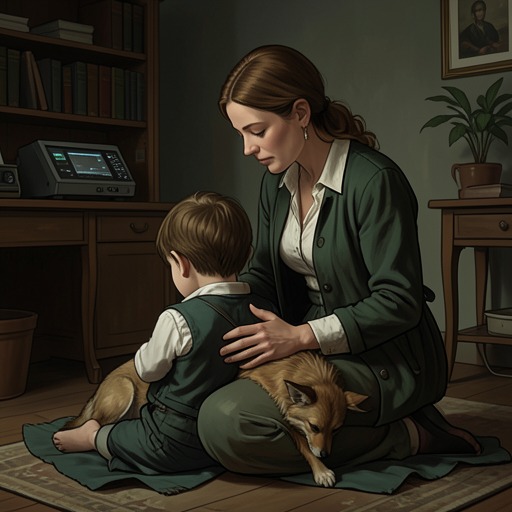
Bridgie McGovern
The Greatest Beer Run Ever: A Memoir of Friendship, Loyalty, and WarBridgie McGovern is a maid in the household of Francis (Frank) McGahern and Susan McGahern, where she becomes a durable presence amid a succession of domestic workers. Her story is brief but consequential: she cooks, washes, sews, and cares for a child while Susan is away, then leaves during Susan’s pregnancy after disagreement about whether she will be expected to nurse and raise another infant. The account presents her not simply as a worker who comes and goes, but as a person whose labor, temperament, and uncertain terms of employment shape the household’s daily life.
Identity and Place in the Household
Bridgie McGovern arrives after a succession of maids and stays longer than any of the others. The narrator describes her as young and attractive, with a flirtatious, egotistical temperament. His sisters later say she flirted with Francis (Frank) McGahern; the narrator adds that the two seemed to get on well. That account suggests a familiarity between employer and employee, though it does not establish what either understood the relationship to mean.
Her position is defined above all by the range of work she undertakes. She cooks and washes for Francis (Frank) McGahern and the children, sews, and minds Monica while the other children are at school. When Susan McGahern is hospitalized and the children do not know where she is, Bridgie remains in the house and looks after the baby. Her responsibilities therefore extend beyond household tasks to the practical care of children during a period when their mother is absent and their father’s authority is newly direct.
Work, Care, and Unequal Authority
The narrative places Bridgie’s employment within a household whose domestic arrangements are shaped by illness, children’s needs, and Francis (Frank) McGahern’s decisions. Her work provides continuity at a time when Susan McGahern’s breast-cancer diagnosis and treatment remove her from everyday family life. The children’s experience of that absence is described through uncertainty and secrecy; Bridgie’s care of the baby is one of the concrete tasks that keeps the household functioning while the adults’ situation remains only partly understood by them.
The account does not portray Bridgie as a substitute mother in any emotional sense, nor does it say that she protects the children from their father’s anger. That protective role is later associated with Katie McManus, whose position and relationship with the children develop differently. Keeping the distinction matters: Bridgie’s documented care is substantial, but the narrative gives it a practical and domestic character rather than attributing to her the later role Katie assumes.
Pregnancy and Disagreement over Her Employment
When Susan McGahern becomes pregnant again, Bridgie complains that she has already nursed and brought up one infant on her own and does not want to do the same for the child expected soon. The text does not identify the earlier infant or specify the precise arrangement under which she had cared for that child. It does establish the burden she says she has already borne, and her reluctance to accept a repeat of it.
Francis (Frank) McGahern interprets Bridgie’s complaint as a ploy to obtain more money. Susan McGahern is less certain. The disagreement exposes a difference in how the employers understand the maid’s protest: Francis treats it as bargaining, while Susan recognizes that Bridgie may genuinely be unwilling to take on the work. Susan’s concern is also practical. She fears Bridgie will leave when the baby arrives and decides that, if leaving is what Bridgie wants, she should be allowed to go.
Departure and Replacement
Bridgie leaves in tears, travelling in Pat McManus’s car. Susan McGahern writes that Bridgie said she would return if the new maid did not suit and that the household would know within a week. Susan suspects Bridgie may not have intended to leave at all, and notes that Pat McManus reported her crying throughout the journey. Yet Susan doubts the grief will last or be deeply rooted. The letters preserve uncertainty rather than resolving it: the departure is emotional, but the motives behind it remain contested.
Pat McManus brings Katie McManus to the house that same evening. Susan’s description makes the replacement a point of comparison: Katie is quieter and less striking in appearance than Bridgie, but seems capable of doing the work and gets on well with the children. Susan also values the fact that Katie does not go out at night. She rejects Francis (Frank) McGahern’s later attempt to reverse course and bring Bridgie back immediately, reasoning that Bridgie chose to leave and that she had grown tired of hearing her threaten to do so. Her decision is firm but measured: she does not claim certainty about Bridgie’s intentions, yet declines to undo the arrangement at once.
Narrative Significance
Bridgie’s account ends with her departure; the narrative gives no later resolution of her life or confirmation that she returned. Her proposed willingness to come back remains part of the circumstances of the leave-taking, not evidence that she resumed the position. The distinction is important because Katie McManus later becomes willing to return after Francis (Frank) McGahern refuses her, and eventually does return through arrangements made by Maggie. That later episode belongs to Katie’s story, not Bridgie’s.
Through Bridgie, the household’s dependence on women’s labor becomes visible in specific tasks: cooking for the family, washing and sewing, minding Monica, and caring for a baby while Susan is away. Her protest over another infant’s care brings the cost of that work into view, while the employers’ differing interpretations show how little control she has over how her complaint is understood. Her tears, her offer to return, and Susan’s refusal to recall her immediately leave the episode without a simple verdict. Bridgie is neither reduced to a scheming employee nor presented as a fully knowable victim; she remains a capable, difficult, and vulnerable worker whose departure marks a real change in the household’s arrangements.